
Welcome to Stories of Feminist Peace, WILPF’s 2025 external Annual Report reimagined as a living calendar of feminist peace in practice. Each story captures a moment of courage, creativity, and resistance from across our global movement, showing how feminist peace is built day by day, even in a world increasingly defined by conflict and repression.
Through these stories, we invite you to witness how WILPF’s movement confronted militarism, defended human rights, and nurtured collective care — all while holding fast to the belief that feminist peace is not a dream, but a practice of courage.
Welcome to WILPF’s 2025 Annual Report, reimagined as a calendar of feminist peace.
Each month captures a moment of courage, creativity, and resistance from across our global movement.
The past year was far from easy. Wars deepened and spread, extremist ideologies gained ground, and governments continued pouring resources into militarism. Civic space contracted, and multilateral systems weakened under political pressure. These realities shaped our work and tested our collective resilience – all while keeping our values at the centre.
And still, we showed up. We spoke truth to power, challenged arms transfers enabling atrocities, called to Move the Money from war to peace, supported partners and nurtured a growing, intergenerational movement for peace.
As we begin this reflection, we hold close a reminder that guided us throughout the year: “Feminist peace is not a dream — it is a daily practice of courage.” Thank you for being part of this journey.
With gratitude,
Amrita & Sylvie
As this calendar comes to a close, we want to thank you for walking with us through a year of challenge and determination.
Every story in these pages shows what our movement can achieve — even when the world feels heavy with violence, fear, and uncertainty. Together, we will keep striving for a world grounded in justice, care, and the protection of human rights for all.
We will step into 2027 with renewed purpose, guided by the strength of our partners, members, and allies around the world.
“Hope is not passive — it is something we build together.”
In solidarity,
Amrita & Sylvie
— building a feminist movement that adapts, includes, and inspires.
In January, two new National Groups, WILPF South Sudan and WILPF Zambia, joined our community, marking a moment of renewal and shared purpose.
Across our movement, members connected through new tools and spaces: the updated WILPF Guide for membership in three languages, a strengthened Young WILPF Network, and a Care & Well-being Resource Package reminding us that solidarity begins with care. Over 100 young activists expressed interest in joining, and 32 became new network members.
Amid global shifts, we stood with Syrian feminists after the fall of the Assad regime, creating space to process, strategise, and imagine a future rooted in feminist peace and justice.
January also brought a contribution to feminist knowledge-building with the publication of the Routledge Handbook of Masculinities, Conflict, and Peacebuilding which includes work by WILPF staff and partners exploring how militarised ideas of masculinity drive violence and shape peace.
I’ve been reading WILPF’s Stories of Feminist Peace 2025, and the January story stood out. It highlights how feminist peace work is growing even in uncertain times — from new WILPF groups in South Sudan and Zambia, to a stronger youth network, new tools for organisers, and solidarity with Syrian feminists envisioning a just future.
A powerful example of how movements keep adapting, connecting, and building hope.
Take a look at the January story: https://shorturl.at/Ymlg2
#StoriesOfFeministPeace #FeministPeace #PeaceBuilding

We welcomed Dr Amrita Kapur as our new Secretary-General, continuing WILPF’s legacy of feminist leadership grounded in collective vision.
Across regions, WILPF members demonstrated the strength of intergenerational and transnational activism. In Europe, Sections carried forward traditions of feminist antimilitarism, while on the African continent WILPF brought feminist perspectives to the 41st GIMAC Pre-Summit Consultative Meeting in Addis Ababa, centring justice, reparations, and human security for Africans and people of African descent.
In the Middle East and North Africa, an exchange convened by ABAAD, PAX, and WILPF’s Mobilising Men for Feminist Peace initiative brought together feminists and peacebuilders to reflect on power, militarised masculinities, and violence, and to reimagine feminist peace with men held accountable as allies.
WILPF also remained active in global Women, Peace and Security spaces as the 25th anniversary of UNSCR 1325 approaches, continuing to press for accountability amid rising militarisation.
Throughout the month, our disarmament programme, Reaching Critical Will, intensified efforts to challenge arms transfers fuelling violence and genocide in Palestine. Ahead of the Arms Trade Treaty meetings, we published a briefing on states’ legal obligations and called for an immediate arms embargo. We joined global campaigns, signed joint statements covered by The Guardian, and publicly exposed corporate complicity in arms transfers. We also advanced feminist analysis on emerging threats like autonomous weapons and AI in warfare, through UN interventions and publishing critical analysis in activist spaces. We also made a submission to the UN Secretary-General’s report on military spending and the Sustainable Development Goals, building on WILPF’s long-standing work in this area.
February’s chapter of WILPF’s Stories of Feminist Peace 2025 is a powerful look at feminist leadership in action. Through intergenerational organising across Spain, Germany, and Africa, the month shows how movements grow through courage and collaboration.
It also highlights WILPF’s critical disarmament work — challenging arms transfers enabling atrocities in Palestine, pushing for an arms embargo, calling out corporate complicity, and raising feminist perspectives on AI and autonomous weapons at the UN.
A strong reminder that feminist peace work is both local and global, rooted in solidarity and unafraid to confront militarism.
➡️ Sharing because this work deserves visibility: https://shorturl.at/Ymlg2
#StoriesOfFeministPeace #FeministPeace #Demilitarisation #PeaceBuilding #Solidarity

As we prepared for the 25th anniversary of UNSCR 1325 — a landmark commitment we have long championed — we confronted the reality that its implementation is stalling amid rising militarism, shrinking civic space, and backlash against gender equality.
In response, we strengthened coordination across the movement and sharpened our collective advocacy. From New York to Geneva, WILPF urged governments to recognise military spending and foreign occupation as feminist issues, while calling out their continued failure to implement Critical Area E of the Beijing Platform for Action.
At the 69th Commission on the Status of Women (CSW), WILPF brought strong, principled perspectives to the forefront. Ludmilla Kwitko, Asia-Pacific Regional Representative, sparked dialogue with a compelling statement at the interactive dialogue on peaceful and inclusive societies, while Secretary-General Dr Amrita Kapur and International President Sylvie Jacqueline Ndongmo spoke at high-level events on Palestine, feminist peace, and mobilising men for gender justice.
Beyond CSW, WILPF remained engaged in other multilateral spaces challenging militarism. At the Third Meeting of States Parties to the Treaty on the Prohibition of Nuclear Weapons (TPNW3), Reaching Critical Will (RCW) led WILPF’s engagement through advocacy, analysis, and coordination, while members and partners – including WILPF Scotland and Edwick Madzimure, President of WILPF Zimbabwe – contributed directly. Together, these efforts reinforced a collective rejection of nuclear weapons and deterrence politics.
We also used this moment to reflect critically on multilateralism itself. Our MENA programme released a Wait A Minute video and companion podcast examining Beijing+30 rhetoric, declining trust in international mechanisms, and the need for renewed global solidarity.
We closed the month by honouring the life and legacy of Edith Ballantyne, whose vision continues to guide WILPF’s feminist peace work.
From CSW69 to high-level UN spaces, WILPF amplified feminist perspectives on peace, Palestine, militarism, and gender justice — while calling out stalled implementation of UNSCR 1325 and the failure to address military spending and occupation as feminist issues.
March also marked stronger feminist alliances, WILPF’s role in the Alliance for Feminist Movements, and a tribute to Edith Ballantyne’s enduring legacy. A powerful reminder that feminist advocacy is about confronting power, not just commemorating commitments.
➡️ Sharing because feminist voices belong at the centre of global decision-making: https://shorturl.at/Ymlg2
#StoriesOfFeministPeace #FeministPeace #PeaceBuilding

— celebrating over a century of feminist peace activism alongside the renewed energy of Young WILPF, whose growing network reflects how the movement continues to evolve.
The month also brought a moment of profound change in Senegal, where the decades-long Casamance conflict finally came to an end. WILPF Senegal and partners supported displaced families returning home, highlighting both the possibility of peace and the care required for long-term recovery.
Globally, WILPF confronted urgent challenges linked to militarisation. When several European countries signalled potential withdrawal from the Mine Ban Treaty, we joined international coalitions in urging states to uphold their commitments and protect communities still living under the threat of landmines.
As military spending climbed to $2.7 trillion, we continued advancing feminist responses to militarisation — contributing to UN processes, engaging young activists, and challenging the idea that security can be built through weapons. Through Reaching Critical Will, we also submitted feminist analysis to the UN Secretary-General on the risks of artificial intelligence in the military domain.
We deepened our knowledge work at the intersections of climate, gender, and armament, releasing a Wait A Minute episode on Earth Day that unpacked the climate–arms nexus and its gendered impacts. We also reflected on the legacy of our Mobilising Men for Feminist Peace project, reinforcing the ongoing need to challenge militarised masculinities.
April’s story in WILPF’s Stories of Feminist Peace is a powerful reflection on legacy and momentum. From celebrating 110 years of feminist peace activism and the growing energy of Young WILPF, to supporting communities returning home after the end of the Casamance conflict in Senegal, it shows what long-term feminist organising can achieve.
It also highlights urgent disarmament work, pushing back against threats to the Mine Ban Treaty and challenging record global military spending with feminist perspectives.
A reminder that honouring history and pushing for change must go hand in hand.
📖 Worth reading: https://shorturl.at/Ymlg2
#WILPF110 #FeministPeace #Disarmament #LegacyAndChange #StoriesOfFeministPeace

— from Ukraine and Palestine to Sudan, Yemen, the Democratic Republic of Congo, South Asia, Latin America, and the Sahel. These crises were not isolated events, but part of a broader pattern rooted in militarism, capitalism, colonialism, and deep inequality.
Against this backdrop, we marked 77 years since the Nakba, affirming that remembrance can be a form of resistance. The Nakba is not only a historical moment for Palestinians, but an ongoing reality of ethnic cleansing, settler-colonialism and apartheid. Through WILPF’s #Nakba77 campaign, we amplified the voices of Palestinian women and girls calling not only for an end to Israel’s impunity and violence, but for dismantling the structures that sustain them.
At the United Nations, we continued pressing for accountability and justice. We challenged harmful gender stereotypes, highlighted how weapons undermine rights and freedoms, and together with Afghan partners, co-hosted a side event at HRC58 that brought voices from inside Afghanistan to the global stage. Through our disarmament programme, RCW also sustained feminist engagement in UN processes on nuclear disarmament and emerging weapons technologies, including the NPT Preparatory Committee and informal consultations on autonomous weapons.
May also marked the launch of our Feminist Political Economy Guide, showing how issues such as austerity, environmental justice, and demilitarisation are interconnected to peace. WILPF UK carried this forward by challenging development aid cuts and hosting a webinar on degrowth – a vision for economies that prioritise people and planet over profit.
Through our MENA programme, we continued advocating for donor approaches that prioritise care, flexibility, and rooted in local realities. This work was reinforced by our New Realities: Women Leading Syria’s Future campaign, which spotlighted Syrian women rebuilding their communities following Assad’s fall. At international donor forums, our Afghan Section and Syrian partners highlighted the urgent need to sustain local activism amid severe funding cuts, helping shift conversations toward long-term, community-led support.
The May chapter of WILPF’s Stories of Feminist Peace 2025 underlined the importance of taking down oppressive structures by highlighting the voices of local changemakers. Women in conflict zones from Palestine to Afghanistan are speaking out about the oppressive structures fuelling violence. Through WILPF, they brought their knowledge and advocacy to international decision-making spaces.
Dismantling oppressive structures starts with individuals at the local level. I support WILPF’s advocacy efforts geared towards directing funds to local activists.
➡️ Learn more about WILPF on www.wilpf.org

at the Financing for Development Conference (FFD4) in Sevilla, calling for urgent divestment from the military-industrial complex and reinvestment in peace. Ahead of the conference, we co-hosted a webinar with Equidad de Género, “What is Missing in the Financing for Development Discussion, exploring how war economies, militarism, sanctions, and Indigenous solutions must be part of any conversation about sustainable development.
At the conference and civil society forums, WILPF emphasises that demilitarisation is key to closing global financing gaps. We spoke at panels on gender justice, climate justice, debt, extractivism, and structural transformation, advancing feminist alternatives to systems that drive inequality. These interventions also opened new spaces for collaboration at the intersection of development and peace.
June also brought important momentum in disarmament advocacy. At the United Nations in New York, governments and civil society came together to shape a new global framework on conventional ammunition. WILPF pushed for a feminist approach, insisting that decisions about weapons cannot be made without the voices of women and communities most affected by armed violence. This advocacy helped ensure that gender-sensitive participation was reflected in the final outcome, setting a precedent for more inclusive security discussions moving forward.
Beyond multilateral forums, WILPF continued strengthening collective strategy and movement-building. We convened global discussions with members to prepare for the upcoming 25th anniversary of UNSCR 1325, and gathered in Amsterdam during the No to NATO Counter Summit to host a public film screening and facilitated dialogue exploring the links between militarised masculinities, forced displacement, and ongoing armed conflicts.
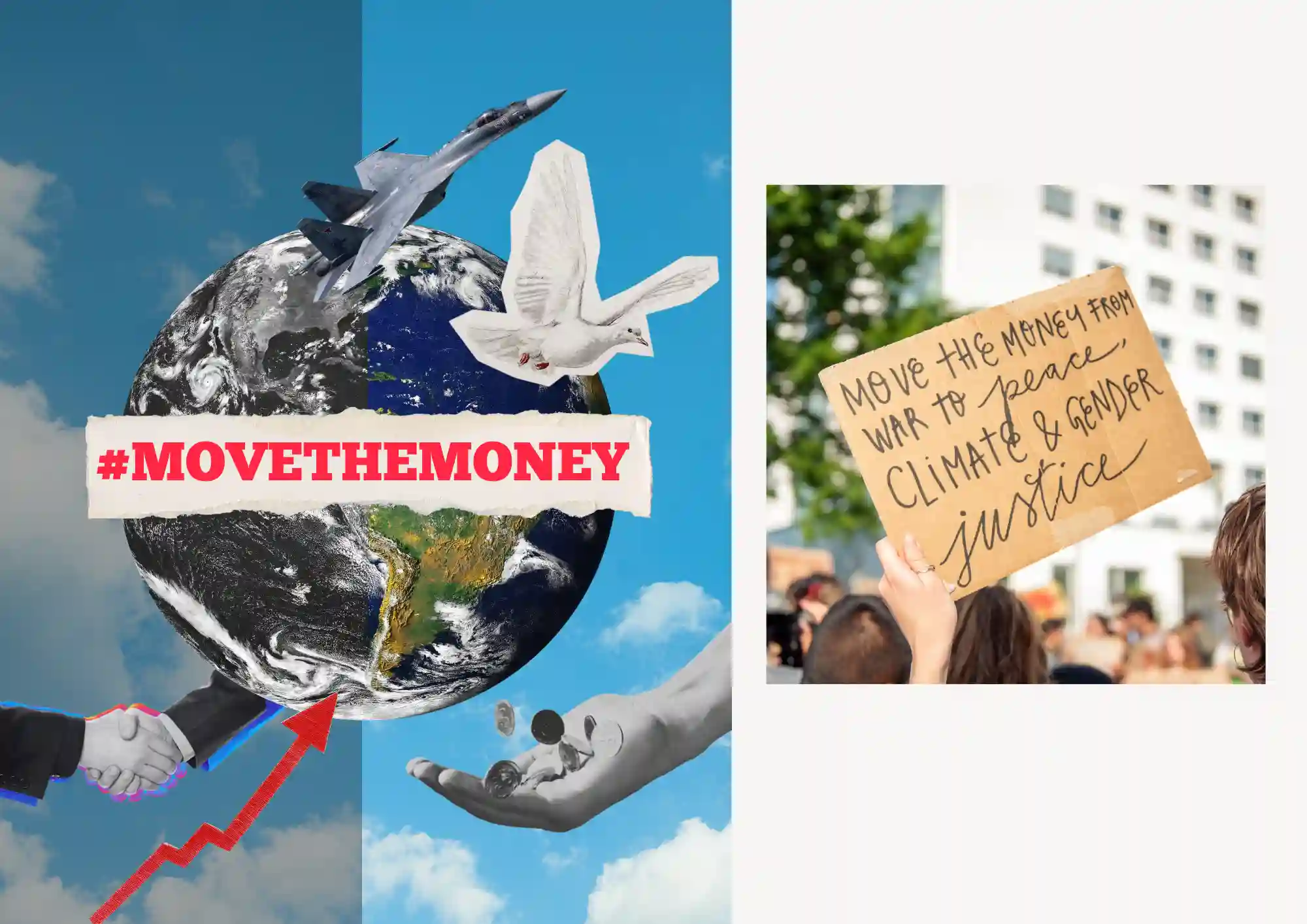
June’s story in WILPF’s Stories of Feminist Peace underlines the importance of continued advocacy to #Movethemoney from military to social institutions (schools, NGOs…). Let’s continue to insist that the voices of those most affected by violence are heard in decision making spaces, like WILPF did in the FFD4 conference and the global framework on conventional ammunition negotiations.
Let’s work together to advocate to change norms and uplift each other’s voices!
➡️ Learn more about the WILPF movement on www.wilpf.org

as members came together globally to review our International Programme and advance preparations for the 2026 Congress. These conversations were crucial for shaping our political vision in a rapidly changing world, reaffirming core feminist and antimilitarist values while assessing where our collective voice is most needed.
WILPF also engaged in the Fourth International Conference on Financing for Development in Sevilla and the High-Level Political Forum on Sustainable Development (HLPF) in New York, bringing feminist peace perspectives into global development debates where they are often completely absent. We highlighted that sustainable development is impossible without confronting militarism and investing in systems that sustain life, not violence.
The month also offered moments of learning and solidarity. From the Seeds of Change webinar on women building peace and protecting the planet, to feminist peace organisations gathering around the 50th anniversary of the Helsinki Final Act, July underscored the growing urgency of feminist peacebuilding. While governments and institutions marked past security frameworks, feminist movements used this moment to call for renewed commitments to cooperation, demilitarisation, and human security amid escalating social, political, and environmental crises.
I’ve been reading WILPF’s Stories of Feminist Peace 2025, and the July story stood out. It underlines that we need to tackle oppressive structures in society to build sustainable futures. Let’s work together to achieve peace by dismantling militaristic systems and promoting environmental protection.
Watch WILPF’s Seeds of Change webinar to learn more about how feminist peace and environmental protection are inextricably intertwined!
➡️ Learn more about WILPF, a collaborative activist movement on www.wilpf.org

in New Mexico, Hiroshima, and Nagasaki – a moment to reflect on the ongoing human and environmental costs of nuclear weapons and to reinforce the urgent need for abolition through the Treaty on the Prohibition of Nuclear Weapons (TPNW).
Throughout this month, we published analysis and advocacy marking these anniversaries, including blogs on the 80th anniversary of the Trinity Test and the bombings of Hiroshima and Nagasaki, a panel discussion reflecting on their legacy today, and joint statements calling for demilitarisation — including on the International Day against Nuclear Tests. Together, these interventions warned of the catastrophic consequences of reliance on nuclear deterrence and called for urgent action to prevent further testing, proliferation, and escalation.
Commemoration and solidarity were central to this work. In Hiroshima and Nagasaki, Japan, WILPF Spain and WILPF Austria attended a nuclear disarmament conference linked to the anniversaries and met with WILPF Japan, strengthening transnational feminist connections and honouring survivors whose voices continue to lead calls for disarmament and justice.
August also marked International Youth Day, with Young WILPF releasing The Cost of Silence — a youth declaration challenging political inaction and calling for action against nuclear weapons, militarism, and intergenerational harm.
I’ve been reading WILPF’s Stories of Feminist Peace 2025, and the August story stood out as a reminder that real security is not achieved by developing new weapons. The 80th anniversary of the bombings in Hiroshima and Nagasaki in 2025 is a powerful reminder that peace should not be built through armed violence.
As tensions rise between nuclear powers, let’s join WILPF in advocating for a safer world.
➡️ Learn more about WILPF’s demilitarization advocacy on www.wilpf.org

amid rising conflict and climate crises by centring collective action and feminist economic demands.
On International Day of Peace, we re-launched our Move the Money campaign urging governments to shift resources away from militarism and toward peace, care, equality and community-led solutions. The campaign became a rallying point across the movement, supported by new advocacy resources including a Move the Money toolkit with ready-to-use social media content and printable materials. We also published analysis linking military spending to the Sustainable Development Goals, the risks of militarised AI, and the ways militarism fuels gender-based violence and exclusion.
Mobilisation continued through Global Weekend of Action, where members and partners stood with Palestinian civil society demanding an end to occupation and apartheid, and highlighted pathways for action through BDS and the End Israel’s Impunity campaign.
During UNGA80 in New York, WILPF brought feminist peace perspectives to high-level spaces, advancing Move the Money demands and calling for states to uphold international law. At the 60th Session of the Human Rights Council , we joined a civil society advocacy calling for an accountability mechanism for Afghanistan. This collective effort contributed to the establishment of an independent accountability mechanism, strengthening pathways to justice and protection for Afghan women and human rights defenders.
The Global Week of Action for Peace and Climate Justice further reinforced this integrated approach. Through analysis on fossil fuels and conflict, the Power, Profits & Patriarchy webinar, and advocacy for the Fossil Fuel Treaty with partners including Fridays for Future, WILPF Colombia (Limpal), and WILPF Spain, WILPF connected demilitarisation with climate and gender justice demands.
I’ve been reading WILPF’s Stories of Feminist Peace 2025, and the September story stood out as a reminder that achieving peace starts by moving funds from the military to building peace and equality.
From attending UNGA80 in New York to disseminating information to the public, WILPF advocates to #Movethemoney away from militaries.
➡️ Learn more about why we should #Movethemoney on www.wilpf.org/move-the-money
reaffirming feminist demands for justice, accountability, and peace amid escalating war and repression. Since the adoption of UN Security Council Resolution 1325, feminist peace movements – including WILPF – have worked to advance this agenda: this year WILPF highlighted how the securitisation of the agenda and lack of accountability has limited its contribution to peace.
Throughout the month, WILPF commemorated the WPS anniversary in New York, Amman, Nairobi, and Geneva – amplifying feminist alternatives to patriarchal and militarised models of security. As governments continued to invest in war rather than peace, WILPF underscored the urgency of the WPS vision in confronting violence, exclusion, and shrinking civic space.
October also saw sustained mobilisation for Palestine. WILPF supported fundraising efforts to reopen WILPF Palestine’s Jerusalem office and backed grassroots organising across Europe, including the Salir de Casa por Gaza Peace Camp organised by WILPF Spain in Brussels, which culminated in a public mobilisation demanding accountability and a military embargo on Israel. WILPF also issued a statement calling for an end to the siege on Gaza, a full two-way arms embargo, and action to dismantle apartheid and settler-colonial violence.
In Geneva, during Geneva Peace Week, WILPF hosted and joined panels advancing feminist approaches to peace, human rights, and transitional justice, including events amplifying voices from Gaza and feminist peace actors from Ukraine and Latin America. Meanwhile, in New York, RCW advanced feminist disarmament perspectives rooted in the WPS agenda at the UN General Assembly First Committee, addressing arms transfers, nuclear risk, and the dangers of military AI.
WILPF’s October chapter of Stories of Feminist Peace 2025 underlined the importance of speaking out against injustice. From the Peace Camp in support of Palestine in Brussels, to uplifting activist voices from Gaza, WILPF activists have made a stand against oppression and occupation.
Let’s continue to work together to advocate for peace in international spaces and on a grassroots level.
➡️ Learn more about WILPF on www.wilpf.org

pushing back against climate approaches that ignore militarism, extractivism, and structural violence. Working alongside the Women and Gender Constituency and partners on the ground, we supported members, including Natalia Chaves Monroy (LIMPAL Colombia) in highlighting the links between militarism, extractivism, and climate harm. Together, we amplified feminist voices throughout COP30 through coordinated action, advocacy materials, and key reflections from Belém.
November also marked an important moment of movement growth with the launch of WILPF Brazil, led by young feminist peace activists who brought a manifesto to COP30 calling for climate justice that uplifts Indigenous women, protects territories, and rejects all forms of violence.
Across the region, WILPF members from Brazil, Colombia, Mexico and Argentina came together in a webinar to address the impacts of militarisation in Abya Yala (Latin America) and share strategies of resistance grounded in feminist solidarity.
At the Reykjavík Global Forum, WILPF’s Secretary-General Dr Amrita Kapur called on governments to move beyond symbolic inclusion and instead invest in feminist movements working to prevent conflict and build lasting peace.
WILPF also marked 17 November as a day of resistance in solidarity with Palestine, condemning the Security Council resolution that provided a rubber-stamp for continued Israeli and Western occupation and colonial policies towards Palestine. Through advocacy, resources, and ongoing support to partners and members, WILPF reaffirmed its commitment to a feminist, sustainable definition of peace – one that centres Palestinian voices, and justice, self-determination, return, and rights.
Climate justice and feminist peacebuilding should be understood as two faces of the same coin: one cannot be achieved without the other. In COP30, WILPF activists pushed for intersectional climate justice because militarism, extractivism, and climate harm go hand in hand.
➡️ Learn more about WILPF’s feminist participation in COP30 on www.wilpf.org/our-work/ecological-justice/

The month brought members together across regions. European Sections met in Vienna to connect, exchange priorities and strategise for the future, while the African Regional Meeting in Lomé strengthened solidarity and coordination among national Sections.
Across the globe, members took part in the 16 Days of Activism Against Gender-Based Violence, amplifying testimonies from women human rights defenders and spotlighting local action that continues to inspire feminist peace work. WILPF also published the blog How Militarism and Militarisation Fuel Gender-Based Violence and Exclusion, linking gender-based violence to militarised policies and reinforcing the need to Move the Money away from war and toward prevention, care, and justice.
December also highlighted feminist resistance and political education. WILPF released new Wait a Minute and Political Is Personal episodes, highlighting ongoing activism under war, occupation, and authoritarianism in Palestine, Syria, Iraq, and Tunisia. Our Human Rights Programme launched a new series of training videos to support members’ engagement with UN human rights mechanisms, drawing on real advocacy experiences from across the movement.
In Sri Lanka, Young WILPF strengthened feminist movement-building through a youth-led podcast series addressing militarisation, gender-based violence, political and economic participation, and youth empowerment. Produced and moderated by young members, the series fostered intergenerational dialogue by bringing together activists, community leaders, and feminist organisers across generations. The month also featured the final Youth Corner of 2025, which explored decolonial approaches to reimagining masculinities and highlighted how young people are challenging rigid power structures today.
I’ve been reading WILPF’s Stories of Feminist Peace 2025, and the December story stood out. Feminist peacebuilding is becoming increasingly challenging in the current geopolitical landscape, with obstacles from natural disasters to increasing military budgets. In 2025, WILPF reached out to their communities through networks of solidarity and care, from providing aid after Cyclone Ditwah in Sri Lanka to taking part in the 16 days of activism against gender-based violence.
➡️ Let’s join WILPF in sustaining our efforts to build a more equal world: www.wilpf.org/become-a-member/

Matt Mahmoudi (he/him) is a lecturer, researcher, and organizer. He’s been leading the “Ban the Scan” campaign, Amnesty International’s research and advocacy efforts on banning facial recognition technologies and exposing their uses against racialized communities, from New York City to the occupied Palestinian territories.

Berit Aasen is a sociologist by training and has worked at the OsloMet Metropolitan University on Oslo. She has 40 years of experience in research and consultancy in development studies, including women, peace, and security, and in later years in asylum and refugee studies. Berit Aasen joined WILPF Norway five years ago. She is an alternate member of the National Board of WILPF Norway, and representing WILPF Norway in the UN Association of Norway, the Norwegian 1325 network and the Norwegian Women’s Lobby. Berit Aasen has been active in the WILPF European Liaison group and is committed to strengthening WILPF sections and membership both in Europe and relations across continents.

Your donation isn’t just a financial transaction; it’s a step toward a more compassionate and equitable world. With your support, we’re poised to achieve lasting change that echoes through generations. Thank you!

Prior to being elected Vice-President, Melissa Torres was the WILPF US International Board Member from 2015 to 2018. Melissa joined WILPF in 2011 when she was selected as a Delegate to the Commission on the Status of Women as part of the WILPF US’ Practicum in Advocacy Programme at the United Nations, which she later led. She holds a PhD in Social Work and is a professor and Global Health Scholar at Baylor College of Medicine and research lead at BCM Anti-Human Trafficking Program. Of Mexican descent and a native of the US/Mexico border, Melissa is mostly concerned with the protection of displaced Latinxs in the Americas. Her work includes training, research, and service provision with the American Red Cross, the National Human Trafficking Training and Technical Assistance Centre, and refugee resettlement programs in the U.S. Some of her goals as Vice-President are to highlight intersectionality and increase diversity by fostering inclusive spaces for mentorship and leadership. She also contributes to WILPF’s emerging work on the topic of displacement and migration.

Jamila Afghani is the President of WILPF Afghanistan which she started in 2015. She is also an active member and founder of several organisations including the Noor Educational and Capacity Development Organisation (NECDO). Elected in 2018 as South Asia Regional Representative to WILPF’s International Board, WILPF benefits from Jamila’s work experience in education, migration, gender, including gender-based violence and democratic governance in post-conflict and transitional countries.

Sylvie Jacqueline NDONGMO is a human rights and peace leader with over 27 years experience including ten within WILPF. She has a multi-disciplinary background with a track record of multiple socio-economic development projects implemented to improve policies, practices and peace-oriented actions. Sylvie is the founder of WILPF Cameroon and was the Section’s president until 2022. She co-coordinated the African Working Group before her election as Africa Representative to WILPF’s International Board in 2018. A teacher by profession and an African Union Trainer in peace support operations, Sylvie has extensive experience advocating for the political and social rights of women in Africa and worldwide.
In response to the takeover of Afghanistan by the Taliban and its targeted attacks on civil society members, WILPF Afghanistan issued several statements calling on the international community to stand in solidarity with Afghan people and ensure that their rights be upheld, including access to aid. The Section also published 100 Untold Stories of War and Peace, a compilation of true stories that highlight the effects of war and militarisation on the region.
Lorem ipsum dolor sit amet, consectetur adipiscing elit. Mauris facilisis luctus rhoncus. Praesent eget tellus sit amet enim consectetur condimentum et vel ante. Nulla facilisi. Suspendisse et nunc sem. Vivamus ullamcorper vestibulum neque, a interdum nisl accumsan ac. Cras ut condimentum turpis. Vestibulum ante ipsum primis in faucibus orci luctus et ultrices posuere cubilia curae; Curabitur efficitur gravida ipsum, quis ultricies erat iaculis pellentesque. Nulla congue iaculis feugiat. Suspendisse euismod congue ultricies. Sed blandit neque in libero ultricies aliquam. Donec euismod eget diam vitae vehicula. Fusce hendrerit purus leo. Aenean malesuada, ante eu aliquet mollis, diam erat suscipit eros, in.
WILPF uses feminist analysis to argue that militarisation is a counter-productive and ill-conceived response to establishing security in the world. The more society becomes militarised, the more violence and injustice are likely to grow locally and worldwide.
Sixteen states are believed to have supplied weapons to Afghanistan from 2001 to 2020 with the US supplying 74 % of weapons, followed by Russia. Much of this equipment was left behind by the US military and is being used to inflate Taliban’s arsenal. WILPF is calling for better oversight on arms movement, for compensating affected Afghan people and for an end to all militarised systems.
Mobilising men and boys around feminist peace has been one way of deconstructing and redefining masculinities. WILPF shares a feminist analysis on the links between militarism, masculinities, peace and security. We explore opportunities for strengthening activists’ action to build equal partnerships among women and men for gender equality.
WILPF has been working on challenging the prevailing notion of masculinity based on men’s physical and social superiority to, and dominance of, women in Afghanistan. It recognizes that these notions are not representative of all Afghan men, contrary to the publicly prevailing notion.
In WILPF’s view, any process towards establishing peace that has not been partly designed by women remains deficient. Beyond bringing perspectives that encapsulate the views of half of the society and unlike the men only designed processes, women’s true and meaningful participation allows the situation to improve.
In Afghanistan, WILPF has been demanding that women occupy the front seats at the negotiating tables. The experience of the past 20 has shown that women’s presence produces more sustainable solutions when they are empowered and enabled to play a role.

